
O papel da nutrição na psiquiatria
Pesquisas indicam uma forte ligação entre nutrição e saúde mental. Acredita-se que uma dieta adequada pode desempenhar tanto um papel preventivo – protegendo contra doenças – quanto um papel de apoio no tratamento de vários transtornos mentais, como depressão, esquizofrenia ou transtornos de ansiedade (Grajek et al., 2022).
Dieta e doenças mentais
As doenças mentais são um problema de saúde grave, que afeta a vida diária de milhões de pessoas em todo o mundo. As condições mais comuns incluem depressão, esquizofrenia, transtorno bipolar e transtornos de ansiedade. O seu tratamento baseia-se principalmente na farmacoterapia e na psicoterapia; no entanto, os investigadores estão cada vez mais a destacar a importância da dieta como um elemento de apoio na terapia. A secção seguinte fornecerá uma visão geral destes transtornos. Se desejar explorar descrições detalhadas e os critérios de diagnóstico utilizados pelos médicos, recomenda-se consultar a CID-11 (Classificação Internacional de Doenças) ou o DSM-5 (Manual Diagnóstico e Estatístico de Transtornos Mentais).
As doenças mentais são distúrbios que afetam a maneira como uma pessoa pensa, sente e se comporta. Elas podem prejudicar o funcionamento diário, como estudar, trabalhar ou manter relacionamentos. Indivíduos que lutam contra esses problemas podem sentir-se tristes, ansiosos, ter dificuldade para se concentrar ou dormir e, às vezes, achar difícil distinguir a realidade da imaginação. Esses distúrbios não são um sinal de «fraqueza» — são condições de saúde reais que podem e devem ser tratadas. Quanto mais cedo forem reconhecidos, maiores serão as chances de um apoio eficaz e de uma melhoria na qualidade de vida.
Depressão
A depressão é um dos transtornos mentais mais comuns, caracterizado por um humor baixo prolongado, falta de energia e perda de interesse nas atividades diárias. Pessoas com depressão também podem apresentar distúrbios do sono, dificuldades de concentração e alterações no apetite.
Os investigadores estão cada vez mais a estudar o impacto da dieta nos sintomas depressivos, destacando a importância dos nutrientes que apoiam a função cerebral. Os ácidos gordos ómega 3, as vitaminas B e os antioxidantes são de particular interesse, pois podem apoiar a função dos neurotransmissores e reduzir a inflamação no corpo. Em alguns estudos, as dietas mediterrânica e cetogénica mostraram efeitos benéficos no alívio dos sintomas da depressão, embora sejam necessárias mais pesquisas nesta área. Estes nutrientes e dietas serão discutidos com mais detalhes posteriormente neste módulo.
Esquizofrenia
A esquizofrenia é um distúrbio mental grave que afeta o pensamento, as emoções e a percepção da realidade. Os seus sintomas incluem alucinações (por exemplo, ouvir vozes), delírios, problemas de concentração e dificuldades no funcionamento social.
Nos últimos anos, os investigadores começaram a explorar o papel da dieta no tratamento da esquizofrenia, particularmente em relação ao metabolismo da glicose e à função mitocondrial no cérebro, ou seja, como as células cerebrais produzem energia. A dieta cetogénica faz com que o corpo obtenha energia principalmente da gordura, em vez do açúcar (hidratos de carbono). Isso resulta na produção dos chamados corpos cetónicos, que substituem a glicose como combustível para o cérebro. Desta forma, a dieta pode apoiar a estabilização da função cerebral e ajudar a reduzir certos sintomas da esquizofrenia. Além disso, seguir uma dieta rica em antioxidantes pode ajudar a proteger as células nervosas contra danos. O papel desta dieta será discutido com mais detalhes posteriormente neste módulo.
Pressão da perturbação bipolar (BD)
A perturbação bipolar é caracterizada por episódios alternados de depressão e mania (excitação excessiva, hiperatividade e, muitas vezes, tomada de decisões impulsivas). Esta condição afeta significativamente o funcionamento diário e requer tratamento farmacológico a longo prazo.
Os investigadores observaram que os indivíduos com TB frequentemente apresentam distúrbios metabólicos e dificuldades em manter níveis estáveis de glicose no sangue. Como resultado, surgiram hipóteses sugerindo que uma dieta cetogénica ou baixa em hidratos de carbono pode ajudar a estabilizar o humor, melhorando a função mitocondrial e regulando os níveis de neurotransmissores. Embora a investigação nesta área ainda esteja em fase inicial, os resultados sugerem que uma dieta bem equilibrada pode ser um elemento útil no apoio à terapia.
Transtornos de ansiedade
Os transtornos de ansiedade incluem várias condições, como ansiedade crónica, ataques de pânico e fobias. As pessoas que sofrem desses transtornos frequentemente apresentam preocupação persistente, tensão muscular e distúrbios do sono.
No contexto dos transtornos de ansiedade, os investigadores estão cada vez mais focados no papel da microbiota intestinal e na sua influência na função cerebral (o eixo intestino-cérebro, que se refere à conexão entre o intestino e o cérebro, o que significa que o que comemos pode afetar como nos sentimos). Uma dieta rica em probióticos (por exemplo, iogurte natural) e em nutrientes que apoiam a produção de serotonina (por exemplo, alimentos ricos em triptofano) pode ter um efeito benéfico na redução da ansiedade. Um número crescente de estudos sugere que uma dieta saudável pode apoiar a estabilidade emocional, embora não deva ser considerada um substituto para o tratamento farmacológico.
ATIVIDADE INTERATIVA 22
O impacto da alimentação na saúde mental
Como mencionado anteriormente, existe uma ligação entre a alimentação e a saúde mental. Por exemplo, o excesso de peso corporal e uma alimentação de má qualidade — como alimentos ultraprocessados, altamente calóricos e pobres em nutrientes essenciais — são considerados fatores significativos que influenciam o bem-estar mental (Grajek et al., 2022).
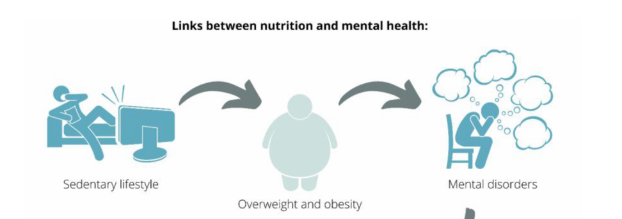
Fonte: Grajek et al. (2022)
Os hábitos alimentares modernos contribuem para o aumento de peso, muitas vezes acompanhado por deficiências nutricionais. Apesar do aumento da ingestão de quilocalorias, o consumo de micro e macronutrientes essenciais — como vitaminas B e magnésio, que são essenciais para o bom funcionamento do sistema nervoso — continua insuficiente. Além disso, tem-se observado um declínio no consumo de vegetais e produtos à base de cereais ricos em fibras. Estes efeitos negativos são ainda mais intensificados por fatores como o tabagismo, a baixa atividade física e o consumo excessivo de álcool, que aumentam o risco de transtornos mentais, incluindo a depressão (Grajek et al., 2022).
O impacto dos componentes bioativos dos alimentos na saúde mental
Um número crescente de estudos mostra que certos compostos bioativos presentes nos alimentos podem influenciar a função cerebral e o bem-estar geral. Os compostos bioativos são substâncias que não são essenciais para a sobrevivência, mas têm efeitos benéficos para a saúde – podem melhorar o humor, reduzir o stress e até mesmo ajudar no tratamento de condições como depressão ou esquizofrenia. Eles atuam de várias maneiras: afetando os neurotransmissores (substâncias químicas no cérebro que nos ajudam a sentir-nos calmos e bem), reduzindo a inflamação (um estado que pode prejudicar o funcionamento do cérebro e piorar o humor) e auxiliando o funcionamento do intestino, que está ligado ao cérebro. Esses compostos são encontrados em alimentos naturais, como vegetais, frutas, nozes e peixes (Grajek et al., 2022).
A tabela abaixo apresenta exemplos de compostos bioativos que devem ser considerados ao planear a dieta de uma pessoa com dificuldades psicológicas
| Nome do composto bioativo | Mecanismo de ação | Fontes alimentares |
|---|---|---|
| Ácidos gordos ómega 3 | Melhora a função cerebral, apoia os neurotransmissores, reduz a inflamação | Peixes gordos (salmão, cavala, sardinha), nozes, sementes de linhaça |
| Polifenóis | Protege os neurónios contra danos, melhora o fluxo sanguíneo para o cérebro e tem efeitos anti-inflamatórios | Chocolate preto, bagas, uvas, chá verde, cacau |
| Triptofano (aminoácido) | Precursor da serotonina («hormona da felicidade»), melhora o humor e ajuda a dormir | Bananas, ovos, peru, leite, nozes, sementes de abóbora |
| Magnésio (mineral) | Apoia o funcionamento do sistema nervoso, reduz o stress | Nozes, sementes de abóbora, produtos integrais, cacau, espinafre |
| Probióticos | Apoia a saúde intestinal, que influencia a função cerebral (eixo intestino-cérebro – a conexão entre o intestino e o cérebro) | Kefir, iogurte natural, alimentos fermentados |
| Vitaminas B (B6, B9, B12) | Melhora a função cerebral, apoia a produção de neurotransmissores | Carne, ovos, leguminosas, produtos integrais, vegetais verdes |
| Zinco (mineral) | Apoia o funcionamento do sistema nervoso, tem efeitos anti-inflamatórios | Carne bovina, nozes, sementes de abóbora, leguminosas, ostras |
| Antioxidantes (por exemplo, vitaminas C, E, carotenóides) | Protege as células cerebrais do stress oxidativo, que pode contribuir para distúrbios mentais | Pimentos, frutas cítricas, cenouras, nozes, azeite |
| S-adenosilmetionina (SAMe) | Ajuda as células cerebrais a funcionar corretamente, melhora o humor | Carne, ovos, produtos integrais |
| N-acetilcisteína (NAC) | Anti-inflamatório, apoia a regeneração das células nervosas | Nozes, sementes, carne, ovos |
Fonte: Grajek et al. (2022)
O papel da alimentação no tratamento de indivíduos com problemas de saúde mental é crucial, pois a nutrição influencia diretamente o funcionamento do cérebro e o bem-estar mental geral. Inúmeros estudos confirmam que maus hábitos alimentares — particularmente o consumo de alimentos ultraprocessados — podem aumentar o risco de depressão, ansiedade e outros transtornos. Em contrapartida, uma alimentação bem equilibrada e rica em nutrientes essenciais pode ter um efeito protetor e auxiliar no processo de tratamento.
Embora a farmacoterapia e a psicoterapia continuem a ser os pilares do tratamento da saúde mental, um número crescente de estudos sugere que uma dieta adequada pode ajudar no progresso terapêutico e melhorar a qualidade de vida dos pacientes. Para trabalhar de forma eficaz com indivíduos que enfrentam desafios de saúde mental, é importante compreender como a dieta afeta a saúde mental e estar familiarizado com estratégias nutricionais específicas que apoiam a terapia.
É essencial lembrar, no entanto, que a dieta nunca deve substituir o tratamento farmacológico. Quaisquer alterações na dieta devem ser feitas sob a supervisão de um médico e um nutricionista para garantir a segurança e a eficácia.
Nos módulos seguintes, exploraremos intervenções alimentares detalhadas, deficiências nutricionais comuns e erros alimentares frequentes cometidos pelos pacientes. Recomendamos que continue a ler para expandir os seus conhecimentos e apoiar melhor as pessoas que lidam com transtornos de saúde mental.
ATIVIDADE INTERATIVA 23
| Bibliography |
| Grajek, M., Krupa-Kotara, K., Białek-Dratwa, A., Sobczyk, K., Grot, M., Kowalski, O., & Staśkiewicz, W. (2022). Nutrition and mental health: A review of current knowledge about the impact of diet on mental health. Frontiers in Nutrition, 9, 943998. https://doi.org/10.3389/fnut.2022.943998 Bhave, V. M., Oladele, C. R., Ament, Z., Kijpaisalratana, N., Jones, A. C., Couch, C. A., Patki, A., Garcia Guarniz, A. L., Bennett, A., Crowe, M., Irvin, M. R., & Kimberly, W. T. (2024). Associations between ultra-processed food consumption and adverse brain health outcomes. Neurology, 102(11), e209432. https://doi.org/10.1212/WNL.0000000000209432 Contreras-Rodriguez, O., Reales-Moreno, M., Fernández-Barrès, S., Cimpean, A., Arnoriaga-Rodríguez, M., Puig, J., Biarnés, C., Motger-Albertí, A., Cano, M., & Fernández-Real, J. M. (2023). Consumption of ultra-processed foods is associated with depression, mesocorticolimbic volume, and inflammation. Journal of Affective Disorders, 335, 340–348. https://doi.org/10.1016/j.jad.2023.05.009 |


